Thank you for providing and maintaining this great suite of tools.
I have been following the guide here to create hclust2 heatmaps and GraPhlAn cladograms for visualization of MetaPhlAn2 profiles.
My GraPhlAn workflow is as follows:
- Generate MetaPhlAn2 abundance profiles for individual fastq files →
sampleA_profile.txt,sampleB_profile.txt,sampleC_profile.txt, etc. - Merge abundance profiles using
merge_metaphlan_tables.py→merged_abundance_table.txt - Create tree and annotation files using
export2graphlan.py→merged_abundance.annot.txtandmerged_abundance.tree.txt - Create xml file using
graphlan_annotate.py→merged_abundance.xml - Generate cladogram and legends using
graphlan.py→merged_abundance.png,merged_abundance_legend.png, andmerged_abundance_annot.png
This produces a cladogram similar to the example provided in the demo linked above. However, I would like to make a cladogram that looks like the cladogram for the human microbiome project, where the rings surrounding the tree are a heatmap showing relative abundances of each species in each sample.

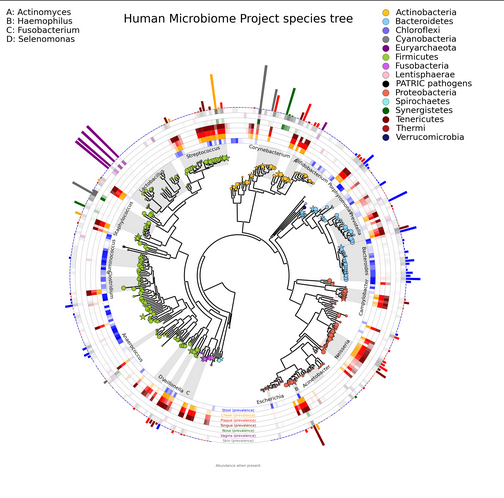
I have been playing around with the options for export2graphlan (e.g. --metadata_rows), but I can’t seem to generate an annotation file that preserves the sample information of my merged abundance table.
My tab-delimited merged_abundance_table.txt file has the following structure:
 ID      sampleA   sampleB   sampleC ...
 #SampleID       Metaphlan2_Analysis     Metaphlan2_Analysis     Metaphlan2_Analysis ...
 k__Bacteria     100.0     63.78929     75.19684 ...
 k__Bacteria|p__Actinobacteria     1.50648     0.0     0.0 ...
 k__Bacteria|p__Actinobacteria|c__Actinobacteria     1.50648     0.0     0.0 ...
 ...
In short, what options can I use in my call of export2graphlan.py to create an annotation file that will encode the sample names and values found in merged_abundance_table.txt, such that graphlan_annotate.py adds the desired heatmap rings annotation to the xml? The biobakery github page does a great job explaining the ring options, but does not explicate how one is meant to programmatically incorporate ring annotations.
Edit
I’m using GraPhlAn version 1.1.3 and MetaPhlAn version 2.5.0.